Daum Pâte de Verre, Explained
Hold a piece of Daum pâte de verre to the light and the colour does not sit on the surface. It seems to occupy the form, sometimes translucent, sometimes densely mineral, often slightly different from one example to the next. That quality is not a glaze and it is not blown glass. It is the result of a slow, deliberate way of making crystal that Maison Daum has made its identity.
This essay explains that method as the house itself describes it, and looks at a few works now at Widen Shop, from a small numbered vase to sculptures issued in editions of eight.
A Nancy house, and a revived material
Jean Daum founded the glassworks in Nancy in 1878. In 1891 his son Antonin established an art department, and the factory became part of the Art Nouveau current associated with the École de Nancy. Official history records a Grand Prize at the Paris World’s Fair of 1900, and, in 1904, the arrival of Amalric Walter, who introduced the pâte de verre technique at Daum after time at Sèvres.
The process is older than the house. It was known in antiquity, then fell out of common use. What Daum did, first at the beginning of the twentieth century and again later, was to apply it with the discipline of a crystal factory. The company notes that glass was permanently replaced by crystal in its production around 1940. From 1968, it says, pâte de verre, made by lost-wax casting, became the house’s identity once more, and collaborations followed with artists including Salvador Dalí, César and, in 1997, Arman.
Daum still works in Nancy. It describes a completely artisanal process, passed down in the workshop, and a palette of 40 shades. Crystal paste, in the house’s own account, contains nearly 30 percent lead, and its colour depends on the weighing of materials, the chemistry of minerals and metals, the temperature of the kiln and the way the piece is cooled.
How a piece is made
The official steps are closer to bronze casting than to glass-blowing, which is why a finished work can hold such fine relief.
A sculptor first models the form by hand in clay. From that model an elastomer mould is taken, flexible enough to keep the smallest details. Hot wax is poured into this mould; once it has hardened, the wax is removed and reworked until it is a faithful reproduction of the original. The wax model is then encased in refractory plaster and placed in an oven. The wax melts and drains away through a prepared channel. It is, in the traditional phrase, “lost”, and the plaster shell that remains is unique to that example.
Crystal granules, which Daum calls groisils, are arranged by colour and size so that, as they melt, they fill the cavity. The oven is heated to 900 degrees, and a piece may require up to 21 days of firing. When the work has cooled, the plaster mould is broken by hand. Finishers polish and refine the surface, the colour is checked, and the piece receives the Daum signature.
Two consequences of this method are worth keeping in mind as a collector. Because the plaster mould is destroyed, each example is cast in its own shell, even within a numbered edition. And because the groisils are placed, not spun in a gather of liquid glass, colour can be composed in depth: amber against a paler edge, a midnight blue that thickens in the folds of a petal. Daum is explicit that every piece is unique and signed, “for better authentication and traceability.”
Living with the material
Pâte de verre is at its best in changing daylight. A sculpture that looks dense on a grey morning can open, an hour later, into something almost liquid. That is the point of the material, and it is why these works reward a little space and a quiet source of light rather than a crowded shelf.
Because each example is signed, the base or an unobtrusive edge is the first place to look when you are confirming a piece. Numbered and limited editions should be described with their edition size or numbering, and the signature should be consistent with a work from the Nancy workshop. As with any crystal, it should be handled and dusted with care; monumental pieces may need specialist delivery, which the shop notes where it applies.
Widen Shop is an authorized distributor of luxury home decor and fine tableware, and names Daum among the houses it represents. Shipping is free on orders over $500, and returns are subject to the published 30-day policy.
Pieces now at Widen Shop
The works below were live when this draft was prepared. They show the same technique at very different scales.
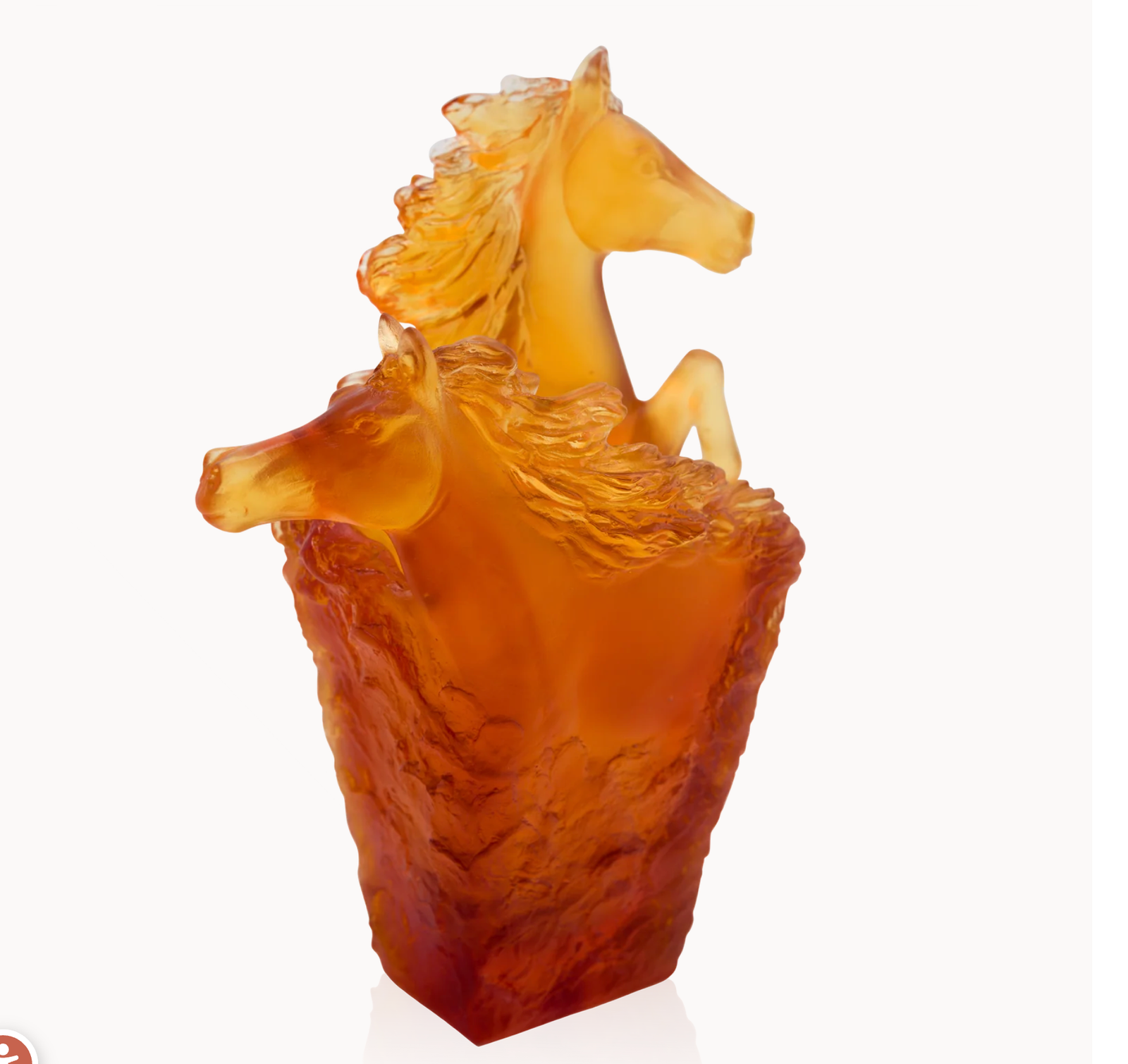
The most approachable entry in this group is Daum Cavalcade Amber Pencil Holder 05715-1, a numbered edition in amber pâte de verre. Two horse heads form a small desk sculpture that also holds pens. The listing gives dimensions of 6.9 by 5.1 by 3.1 inches and a weight of 2.1 pounds, and notes that each example is signed Daum France. SKU 05715-1, $1200.00.
The Arum vases, also numbered, take a floral subject and keep it on an intimate scale, each 6.9 inches high. Daum Arum Pink Small Vase is listed in pâte de cristal, in an amber-pink tone, reference 05723-1, $1800.00. Daum Arum Bleu Nuit Small Vase, reference 05723, is the same size in a deep midnight blue, $1612.00.
At a larger scale, Daum Panther Head Sculpture by Patrick Villas is listed as a limited edition of 125, made by the lost-wax technique. The listing gives a height of 14.1 inches and a weight of 60.4 pounds, and names the Antwerp-trained sculptor Patrick Villas. SKU 05607, $21335.00.
Two works from editions of eight sit at the high end of the present list. Daum Tranchlucide Black & Sterling Silver by Arman unites black crystal with embedded sterling silver on a satin black patinated bronze base. Official Daum history records a collaboration with Arman in 1997; the listing describes this sculpture as part of that artistic partnership, limited to eight pieces, 26 inches high. SKU 03841, $308178.00.
Daum Prestige Eagle 05595, sculpted by Madeleine van der Knoop, is also limited to eight. The listing describes a work in pâte de cristal with patinated bronze, a polished Zimbabwe black granite base, and yellow sapphires and onyx set in yellow gold for the eyes. With the base, it stands 98.4 inches high and weighs 454 pounds. The shop notes that delivery requires specialist fine-art transport. SKU 05595, $500000.00.
If you are considering a particular colour, edition or subject that is not listed, the shop invites a message to support@widenshop.com or via WhatsApp.
Pâte de verre is not a finish applied at the end of a process. It is the process: clay, wax, plaster, crystal, fire, and a signature. Once you have seen how it is made, the way the light moves through a small amber horse, or through a monumental eagle, becomes easier to understand, and harder to confuse with anything else.
If you would like collecting notes, new essays and selected pieces from the shop, you can subscribe to the WidenShop Journal newsletter. We write occasionally, and you can unsubscribe at any time.
Sources
- Daum, “History – 140 years of expertise”, https://daum.fr/en/pages/historique-de-la-creation-maison-daum
- Daum, “From crystal… to crystal paste” (know-how), https://daum.fr/en/pages/our-know-how-daum
- Musée de l’École de Nancy, “Auguste et Antonin Daum”, https://musee-ecole-de-nancy.nancy.fr/en/art-nouveau/the-protagonists-of-the-ecole-de-nancy/auguste-et-antonin-daum
- Widen Shop, About, https://www.widenshop.com/about
- Widen Shop, product listings for SKUs 05715-1, 05723-1, 05723, 05607, 03841 and 05595, prices verified 24 November 2026